
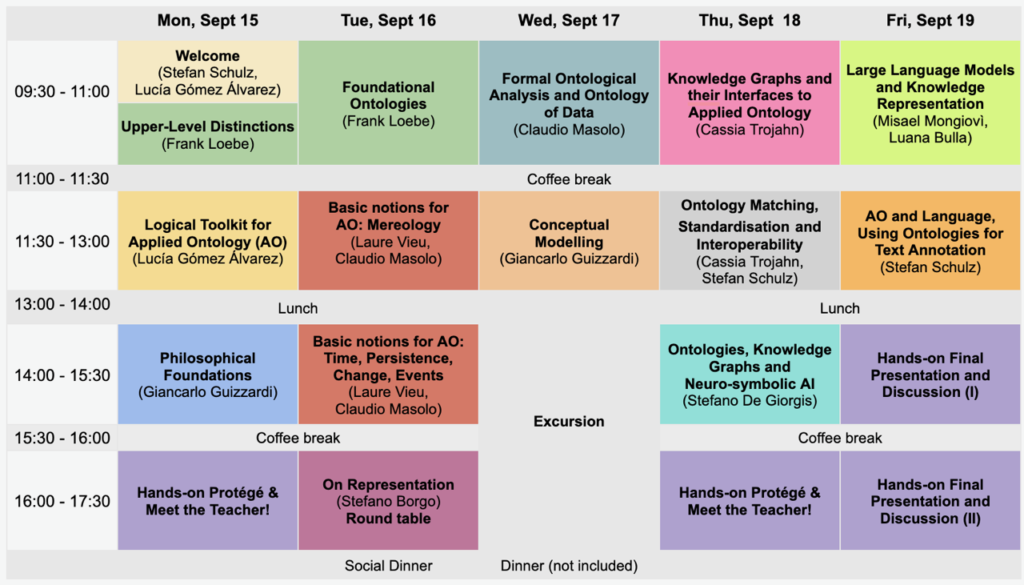
Schedule
Resources
Github repository: https://github.com/dfsantamaria/FOIS-20025
Speakers / Tutors
- Cassia Trojahn Dos Santos, Université Grenoble Alpes, France
- Claudio Masolo, CNR, Italy
- Frank Loebe, University of Leipzig, Germany
- Giancarlo Guizzardi, University of Twente, Netherlands
- Laure Vieu, CNRS, Université de Toulouse, France
- Luana Bulla, University of Catania, Italy
- Lucía Gomez Álvarez, Inria, Université Grenoble Alpes, France
- Misael Mongiovì, University of Catania, Italy
- Stefan Schulz, Medical University of Graz, Austria
- Stefano De Giorgis, CNR, Italy
Course Description
Upper-level distinctions (Frank Loebe)
As the school’s initial lecture, it starts with briefly surveying the landscape of Applied Ontology research and its motivations. Then it tunes in to concepts and distinctions that are fundamental for the field, which also paves the ground for the lecture on foundational ontologies. The notions to be covered range from very basic distinctions such as that between types/classes and (ontological) individuals to other common distinctions that are widespread across (not only) various foundational ontologies. The terminological plurality that affects these notions will be addressed explicitly, including with regard to other fields and contexts.
Logical Toolkit for Applied Ontology (Lucía Gómez Álvarez)
This short course offers a foundational toolkit in logic tailored to the needs of applied ontology. It will start by introducing the syntax and semantics of First-Order Logic (FOL). Participants will learn to interpret and formalise natural language statements into FOL and understand the notions of satisfiability and entailment. The course then discusses the limitations of FOL from a computational point of view (the satisfiability problem in FOL is undecidable), which motivates the use of decidable fragments such as Description Logics (DLs). A focus is placed on the lightweight logic EL, known for its tractability and practical relevance in biomedical ontologies. Participants will gain hands-on experience using Manchester syntax to build a simple TBox and explore the connections between FOL, DLs, and Semantic Web standards such as RDF. Real-world examples, such as SNOMED CT, illustrate the application of these logical tools in ontology engineering.
Philosophical foundations for AO (Giancarlo Guizzardi)
This short course will discuss the ontological foundations for Applied Ontology, focusing on the Unified Foundational Ontology (UFO) and its ontological micro-theories and distinctions. In particular, it covers four micro-theories of UFO that are almost unique among existing foundational ontologies, namely: (1) Types and taxonomic structures, i.e., the ontological, cognitive, and logical foundations of endurant types and how they can be combined to form sound taxonomic structures; (2) Relations and Relationships, i.e., a theory of relations and relationships (truthmakers of relational propositions); (3) Events, i.e., a theory of event mereology, causation, object participation, qualification, and disposition activatiosesn; and (4) Processes, i.e., a theory of on-going mutable occurrences and how they relate to events.
Foundational ontologies (Frank Loebe)
After motivating foundational ontologies briefly, the first main goal of this lecture is to equip students with an understanding of which foundational ontologies are available, briefly also referring to their origins and current status. Secondly, the lecture aims at presenting selected systems in more depth, namely (at least) BFO, DOLCE and UFO. For this purpose, it builds on fundamental upper-level concepts and distinctions, showing interconnections between constituents of these systems on the one hand, while indicating distinct choices made and resulting variations at more detailed levels.
Basic notions of ontology for AO (mereology) (Laure Vieu, Claudio Masolo)
This lecture introduces students to a fundamental topic in formal ontology, mereology – the study of parthood – and part-whole relations, exploring their various facets and some possible extensions. We present and study different mereologies, or axiomatic theories of parthood, both classical and non-classical, and their links with the notions of identity, unity, plurality, and collection. We explore how mereologies can be extended to represent the structural relations of parts forming a whole. Finally, we focus on recent work on slot mereologies, relevant especially for information entities.
Prerequisites: basic knowledge of first-order logic and model theory.
Basic notions of ontology for AO (time, persistence, change, events) (Laure Vieu, Claudio Masolo)
This lecture introduces students to the debate on the theories of time, persistence, and change. It also addresses issues on the nature of events. We introduce three types of temporal structures: (i) one based on time instants and precedence; (ii) one based on time intervals, which requires an interaction between precedence and parthood; (iii) one based on events, from which time instants or intervals can be built. We then present different theories of persistence through time, such as perdurantism and endurantism, and examine how change can be taken into account in these theories, highlighting the associated advantages and disadvantages in terms of knowledge representation and conceptual modeling.
Prerequisites: basic knowledge of first-order logic and model theory.
Formal ontological analysis and ontology of data (Claudio Masolo)
Ontology engineering, conceptual modeling, and knowledge representation mainly focus on characterizing the structure of a given domain, i.e., identifying a set of concepts and relations, together with the constraints that characterize them. In this context, data are typically reduced to factual instantiations of (part of) the model. Data sharing can then be achieved by standardizing, integrating, or partially aligning the models, with the subjective dimension confined to different models of the ‘same domain’. Recently, a vast amount of data collected by heterogeneous sensors or resulting from complex analyses is made available on the web. The homogeneity of the data considered and the understanding of their provenance have a critical impact on the quality, reliability, validity, and trustworthiness of the analyses performed on these data. This leads to the need to explicitly represent the nature of data and how they have been acquired, produced, modified, etc. A shared model of the domain is not enough, a shared model of data is also needed. Measurements, observations, and analyses have a ‘subjective’ nature that transcends the conceptual apparatus necessary to express domain snapshots, representing a step towards an operationalist or constructivist stance on data.
This lecture introduces students to the ontological and formal analyses of the manifold nature of data from a multidisciplinary perspective. (1) It surveys the models developed in computer science that represent the nature, provenance, and transformations of data (e.g., SOSA and PROV-O). (2) It situates these models in relation to the foundational work done in (philosophy of) physics (measurement) and cognitive science (perception and classification). (3) It identifies and discusses the core ontological notions for modeling data.
Prerequisites: basic knowledge of first-order logic.
Conceptual modelling (Giancarlo Guizzardi)
In this short course, we leverage the foundations discussed in the course “Philosophical Foundations for Applied Ontology” to present several engineering tools for conceptual modelling. These tools are based on these foundations and centred around the modelling language OntoUML. They include catalogues of ontology design patterns and anti-patterns, as well as computational tools for model verification, validation, code generation, complexity management of large models, and model auto-repair and evolution. Finally, we will also discuss the relation between Ontology and Explanation, and how an approach for model explanation called Ontological Unpacking—based on truthmaking explanation, the unificatory approach to explanation, and pragmatic explanation—can be used as a methodological tool for systematically producing conceptual models that can serve as references for semantic interoperability in critical domains.
Knowledge graphs and their interface to Applied Ontology (Cassia Trojahn)
This lecture introduces participants to the background concepts of knowledge graphs and to the intersections between knowledge graphs and applied ontology, two central notions in the representation and management of structured knowledge. The session will begin by introducing the structure of knowledge graphs, illustrating how they organise knowledge using different graph-based models enriched with ontological context. We will then delve into applied ontology, highlighting its role in providing formal, logical frameworks for knowledge graphs, which enable machine-readable meaning and interoperability across domains. Throughout the session, we will examine how ontologies underpin the construction, alignment, and reasoning capabilities of knowledge graphs.
Ontology matching, standardisation and interoperability (Cassia Trojahn, Stefan Schulz)
This lecture focuses on ontology matching, a task aiming at achieving semantic interoperability across heterogeneous data sources. We will introduce the basis of the matching process (e.g., alignment features, parameters) and discuss classical approaches (including lexical, structural, and semantic techniques). We will then discuss how recent advances in Large Language Models (LLMs) are being leveraged to enhance the ontology matching task.. From embedding-based similarity computation to few-shot learning and zero-shot matching, we will analyse how LLMs are reinventing the task.
Some topics addressed, driven by examples from biomedicine:
- Human phenotype ontology vs. SNOMED CT – qualities or material or processes
- ICD-10 vs. SNOMED CT – mutual exclusive vs. overlapping classes: labelling problem (intension / extension mismatch)
- HL7-FHIR vs. SNOMED CT values for contextual features: lack of definition
- FMA vs. SNOMED: canonical or clinical anatomy?
- ChEBI vs. SNOMED: chemical entities: chemical graphs vs. single molecules vs. amounts of stuff
- Biological sequences: classes of material entities or information entity instances?
Ontologies, Knowledge Graphs, and Neuro-symbolic AI (Stefano De Giorgis)
This lecture introduces participants to a methodology for augmenting knowledge graphs using a cognitively inspired modular neuro-symbolic pipeline. Centered on practical implementation, the session will guide students through the step-by-step process of constructing semantically rich RDF graphs from visual data (images), starting with neural object recognition (in particular, the YOLO model). Participants will learn how to integrate and align these graphs with established Semantic Web resources such as PropBank, WordNet, VerbAtlas, and the DOLCE foundational ontology. Emphasis will be placed on the spatial grounding of RDF entities within the source image, as well as on techniques for extending the graph using commonsense inferences derived from large language models (LLMs). By the end of the lesson, participants will have a hands-on understanding of how to enrich knowledge representations with implicit information, supporting applications in cognitive systems that require predictive reasoning, risk detection, and proactive decision-making.
Brief list of topics covered:
- LLMs, KG, and Ontologies interaction
- From unstructured (free text) to structured (knowledge graphs) information (AMR2FRED tool)
- Using ontologies (foundational, domain, and application ontologies) with generative AI
- Neurosymbolic architectures for knowledge extraction and knowledge enrichment: from unstructured raw multimodal data to grounded knowledge graphs
Large Language Models and Knowledge Representation (Misael Mongiovì, Luana Bulla)
This lecture introduces the fundamentals of Large Language Models (LLMs), and their transformative role in ontology development. The session begins with an overview of the theoretical foundations of LLMs, including distributional semantics, word embeddings, and probabilistic language modeling. Special attention is given to the Transformer architecture and its evolution through models that led to the development of ChatGPT. Participants gain insight into how these models acquire emergent abilities and how they scale with computational resources. A recent advancement in constrained decoding, which enables generating structured output with guarantees, is discussed.
The lecture then shifts its focus to the intersection of LLMs and knowledge representation, exploring how LLMs can support and enhance the construction and refinement of ontologies. Practical applications are discussed, including concept and relation extraction, entity alignment, ontology enrichment, and validation. Techniques such as zero-shot and few-shot prompting, fine-tuning, and prompt engineering are presented as methods to guide LLMs in tasks traditionally reserved for manual or rule-based ontology engineering.
AO and Language with a focus on using ontologies for annotating technical documents (Stefan Schulz)
In many domains, facts and knowledge are primarily encoded in natural language, e.g., in biomedical research and healthcare. Particularly in these fields, precise categorisations are important, e.g. for defining patient cohorts for clinical trials, triggering alerts or presenting suggestions in clinical information systems. This explains the huge effort invested in
- More or less ontology-based vocabularies such as SNOMED CT, ICD, or LOINC
- Documentation templates, such as those developed by HL7-FHIR
- Annotated text corpora such as MIMIC-III, CANTEMIST, GemTeX
Often, annotation efforts, e.g. connecting text passages (“entities”) with semantic identifiers (“labels”), which then are furthermore related via “relation annotations” as to represent the document semantically, remain at the surface.
The traditions of NLP and text mining have evolved largely uninformed by Applied Ontology, and use-mention confusions are commonplace, i.e. language expressions are not clearly distinguished from their referents.
Yet, the mismatch between similar language expressions (and, in consequence, isomorphic annotation graphs) and their referents is striking, comparing:
- “planned pregnancy” with “complicated pregnancy
- “past history of stroke” with “family history of stroke”
- “severe allergy” with “suspected allergy”
I will report on the efforts made in the sense of deriving ontology-based knowledge graphs from annotation graphs to deep knowledge graphs, based on
- A set of clinical texts
- The standards SNOMED CT and FHIR
- An annotation guide that provides detailed instructions to human annotators
This lecture is on work in progress and focuses on theoretical, case-based discussions, rather than presenting actionable implementations.