 There are at least three ways to allocate and
use multidimensional arrays with size decided at runtime.
There are at least three ways to allocate and
use multidimensional arrays with size decided at runtime.Question: can we return an array from a function?
A statically allocated array fails:
#include <stdio.h>

#define N 32

int* calc_avg(const int in[]) {
    int out[N];
    int i = 0;

    out[i] = (in[i] + in[i+1])/2;

    for (++i; i < N-1; ++i) {
        out[i] = (in[i-1] + in[i] + in[i+1])/3;
    }

    out[i] = (in[i-1] + in[i])/2;

    return out;
}

int main(void) {
    int vec[N];
    int *avg;
    int i;

    for (i=0; i < N; ++i)
        vec[i] = i & 1 ? (3*i +1) : (i>>1);

    avg = calc_avg(vec);

    for (i=0; i < N; ++i)
        printf("%u\t%d\t%d\n", i, vec[i], avg[i]);
}
| |
| |
It works if it's dynamically allocated:
#include <stdio.h>
#include <stdlib.h>

#define N 32

int* calc_avg(const int in[]) {
    int *out = calloc(N,sizeof(*in));
    int i = 0;

    out[i] = (in[i] + in[i+1])/2;

    for (++i; i < N-1; ++i) {
        out[i] = (in[i-1] + in[i] + in[i+1])/3;
    }

    out[i] = (in[i-1] + in[i])/2;

    return out;
}

int main(void) {
    int vec[N];
    int *avg;
    int i;

    for (i=0; i < N; ++i)
        vec[i] = i & 1 ? (3*i +1) : (i>>1);

    avg = calc_avg(vec);

    for (i=0; i < N; ++i)
        printf("%u\t%d\t%d\n", i, vec[i], avg[i]);
}
| |
| |
Local variables are allocated on the stack, which gets freed when
the function returns. If you want to return a pointer to something,
you must use malloc and friends.
Better idea: let the caller pass you a non-const pointer to
pre-allocated memory instead, and return void.
malloc#include <stdio.h>
#include <stdlib.h>
int main(void) {
long int *vector;
/* size_t is unsigned. Assuming 2's complement, -1 cast to size_t
means a size_t with all bits set to 1, i.e. the highest unsigned
value it can represent */
size_t numels = (size_t)-1 / sizeof(*vector) + 1;
/* this overflows! */
size_t mem = numels*sizeof(*vector);
printf("allocating %lu bytes for %lu elements of size %lu\n",
mem, numels, sizeof(*vector));
vector = malloc(mem);
if (vector == NULL) {
fprintf(stderr, "allocation failed\n");
return 1;
}
/* allocation succeeds, but we got less memory than we wanted.
we can now access memory beyond what was assigned to us:
security risk, might segfault, etc */
printf("the last element is %d\n", vector[numels-1]);
}
| |
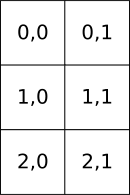
malloc There are at least three ways to allocate and
use multidimensional arrays with size decided at runtime.
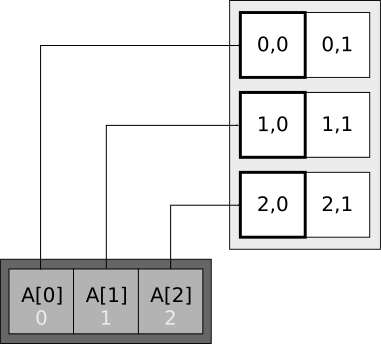
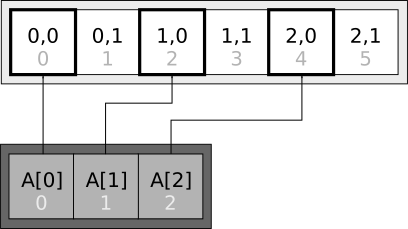
If we want to use double-index notation A[i][j] we need to allocate memory
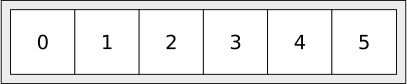
for the data but also for the indices. We can be more efficient if we limit
ourselves to the A[i*ncols+j] notation.
/* file: multi-malloc0.h */
#include <stdio.h>
#include <stdlib.h>

typedef unsigned int uint;

/* allocate each row, returning the number of rows for which
   allocation succeeded */
int init_rows(int **matrix, uint rows, uint cols) {
    size_t memsize = cols*sizeof(**matrix);
    uint row;
    for (row = 0; row < rows; ++row) {
        printf("allocating %lu bytes for row %u\n",
            memsize, row);
        matrix[row] = (int *)malloc(memsize);
        if (matrix[row] == NULL)
            break;
    }
    return row;
}

/* free each row */
void free_rows(int **matrix, uint rows) {
    uint row;
    for (row = 0; row < rows; ++row)
        free(matrix[row]);
}

void init_matrix(int **matrix, uint rows, uint cols) {
    uint row, col;
    for (row = 0; row < rows; ++row)
        for (col = 0; col < cols; ++col)
            matrix[row][col] = row - col;
}

void print_matrix(int **matrix, uint rows, uint cols)
{
    uint row, col;
    for (row = 0; row < rows; ++row) {
        for (col = 0; col < cols; ++col) {
            printf("%d", matrix[row][col]);
            if (col < cols - 1)
                printf("\t");
        }
        printf("\n");
    }
}
| /* file: multi-malloc0.c */
#include "multi-malloc0.h"
int main(int argc, char **argv) {
int **A;
uint rows, cols, els;
size_t memsize;
if (argc != 3) {
fprintf(stderr, "please specify two numbers\n");
return 1;
}
rows = atoi(argv[1]); cols = atoi(argv[2]);
/* check overflow for rows*sizeof(*A) */
if ((size_t)-1 / sizeof(**A) < rows) {
fprintf(stderr, "too many elements!\n");
return 1;
}
memsize = rows*sizeof(*A);
printf("allocating %lu bytes for %u row indices\n", memsize, rows);
A = (int **)malloc(memsize);
if (A == NULL) {
fprintf(stderr, "allocation failed\n");
return 1;
}
/* check overflow for cols*sizeof(**A) */
if ((size_t)-1 / sizeof(**A) < cols) {
fprintf(stderr, "too many elements!\n");
return 1;
}
/* allocate rows */
els = init_rows(A, rows, cols);
if (els != rows) {
fprintf(stderr, "allocation failed at row %d", els);
free_rows(A, els);
return 1;
}
init_matrix(A, rows, cols);
print_matrix(A, rows, cols);
free_rows(A, els); free(A);
}
|
| |
/* file: multi-malloc.h */
#include <stdio.h>
#include <stdlib.h>

typedef unsigned int uint;

void init_rows(int **matrix, uint rows, uint cols, int *mem) {
    uint row;
    for (row = 0; row < rows; ++ row)
        matrix[row] = mem + row*cols;
}

void init_matrix(int **matrix, uint rows, uint cols) {
    uint row, col;
    for (row = 0; row < rows; ++row)
        for (col = 0; col < cols; ++col)
            matrix[row][col] = row - col;
}

void print_matrix(int **matrix, uint rows, uint cols)
{
    uint row, col;
    for (row = 0; row < rows; ++row) {
        for (col = 0; col < cols; ++col) {
            printf("%d", matrix[row][col]);
            if (col < cols - 1)
                printf("\t");
        }
        printf("\n");
    }
}
| /* file: multi-malloc.c */
#include "multi-malloc.h"
int main(int argc, char **argv) {
int **A; int *A_mem;
uint rows, cols, els;
size_t memsize;
if (argc != 3) {
fprintf(stderr, "please specify two numbers\n");
return 1;
}
rows = atoi(argv[1]); cols = atoi(argv[2]);
els = cols * rows; /* this can overflow too, actually */
/* check overflow for rows*sizeof(*A) */
if ((size_t)-1 / sizeof(*A) < rows) {
fprintf(stderr, "too many elements!\n");
return 1;
}
memsize = rows*sizeof(*A);
printf("allocating %lu bytes for %u row indices\n", memsize, rows);
A = (int **)malloc(memsize);
if (A == NULL) {
fprintf(stderr, "allocation failed\n");
return 1;
}
/* check overflow for els*sizeof(*A) */
if ((size_t)-1 / sizeof(**A) < els) {
fprintf(stderr, "too many elements!\n");
return 1;
}
memsize = els*sizeof(**A);
printf("allocating %lu bytes for %u (%ux%u) elements\n",
memsize, els, rows, cols);
A_mem = (int *)malloc(memsize);
if (A_mem == NULL) {
fprintf(stderr, "allocation failed\n");
free(A);
return 1;
}
init_rows(A, rows, cols, A_mem);
init_matrix(A, rows, cols);
print_matrix(A, rows, cols);
free(A_mem); free(A);
}
|
| |
/* file: multi-malloc2.h */
#include <stdio.h>
#include <stdlib.h>

typedef unsigned int uint;

void init_matrix(int *matrix, uint rows, uint cols) {
    uint row, col;
    for (row = 0; row < rows; ++row)
        for (col = 0; col < cols; ++col)
            matrix[row*cols+col] = row - col;
}

void print_matrix(int *matrix, uint rows, uint cols)
{
    uint row, col;
    for (row = 0; row < rows; ++row) {
        for (col = 0; col < cols; ++col) {
            printf("%d", matrix[row*cols+col]);
            if (col < cols - 1)
                printf("\t");
        }
        printf("\n");
    }
}
| /* file: multi-malloc2.c */
#include "multi-malloc2.h"
int main(int argc, char **argv) {
int *A;
uint rows, cols, els;
size_t mem = sizeof(*A);
if (argc != 3) {
fprintf(stderr, "please specify two numbers\n");
return 1;
}
rows = atoi(argv[1]); cols = atoi(argv[2]);
els = cols * rows; /* this can overflow too! */
if ((size_t)-1 / mem < els) {
fprintf(stderr, "too many elements!\n");
return 1;
}
mem *= els;
printf("allocating %lu bytes for %u (%ux%u) elements\n",
mem, els, rows, cols);
A = (int *)malloc(mem);
if (A == NULL) {
fprintf(stderr, "allocation failed\n");
return 1;
}
init_matrix(A, rows, cols);
print_matrix(A, rows, cols);
free(A);
}
|
| |
#include <stdio.h>

char fname[] = "hello-write.txt";

int main(void)
{
    FILE *fd = fopen(fname, "w");
    if (fd == NULL) {
        fprintf(stderr, "failed to open %s for writing!\n", fname);
        return 1;
    }
    fprintf(fd, "Hello world!\n");
    if (ferror(fd)) {
        fprintf(stderr, "error writing to %s!\n", fname);
        fclose(fd);
        return 1;
    }
    fclose(fd);
    return 0;
}
| |
#include <stdio.h>
#include <stdlib.h>

char fname[] = "read-vec.dat";

int main(void)
{
    int *vec, min, max;
    unsigned int size;
    unsigned int i;
    int scancheck;
    FILE *fd;

    fd = fopen(fname, "rb");
    if (fd == NULL) {
        fprintf(stderr, "failed to open %s!\n", fname); return 1;
    }

    /* read the intial "N=..." sequence */
    scancheck = fscanf(fd, "N=%u", &size);
    if (scancheck != 1) {
        fprintf(stderr, "file does not specify number of elements\n"); return 1;
    }
    if ((size_t)-1 / size < sizeof(*vec)) {
        fprintf(stderr, "too many elements\n"); return 1;
    }
    vec = (int *)calloc(size, sizeof(*vec));
    if (vec == NULL) {
        fprintf(stderr, "failed to allocate memory\n"); return 1;
    }
    for (i = 0; i < size; ++i) {
        /* fscanf automatically skips whitespace */
        scancheck = fscanf(fd, "%d", vec + i);
        if (scancheck != 1) {
            fprintf(stderr, "failed to read element %u\n", i); return 1;
        } else if(ferror(fd)) {
            fprintf(stderr, "error in input file\n"); return 1;
        } else if (feof(fd)) {
            fprintf(stderr, "file ended prematurely\n"); return 1;
        }
    }
    close(fd);

    printf("%u elements read\n");

    return 0;
}
| |
| |
#include <stdio.h>
#include <stdlib.h>
#include <string.h>

struct student {
    char famname[256]; char givname[256]; char regnum[256];
    unsigned int mark;
};

char fname[] = "read-ws.dat";

#define MAXSTUD 256

int main(void)
{
    unsigned int i, best, worst;
    FILE *fd;
    /* use calloc() to ensure data is all 0 at the beginning */
    struct student *studs = calloc(MAXSTUD,sizeof(struct student));
    if (studs == NULL) {
        fprintf(stderr, "failed to allocate memory for student records!\n");
        return 1;
    }

    fd = fopen(fname, "rb");
    if (fd == NULL) {
        fprintf(stderr, "failed to open %s!\n", fname);
        return 1;
    }

    for (i=0; i < MAXSTUD; ++i) {
        char line[256];
        size_t last = 0;
        /* reads a line, or up to sizeof(line) bytes */
        char *ptr = fgets(line, sizeof(line), fd);
        /* ptr is NULL if an error or EOF was met */
        if (ptr == NULL) {
            if (feof(fd)) break;
            fprintf(stderr, "error reading from %s!\n", fname);
            return 1;
        }
        /* strlen gives the length of a C string */
        last = strlen(ptr);
        /* if fgets read 255 characters, it means it didn't manage to get a
       full line. this should be handled properly, we just quit */
        if (last == 255) {
            fprintf(stderr, "line %d too long in %s!\n", i, fname);
            return 1;
        }

        last -= 1;
        /* now last points to the last character in the string
          (before the null byte). If it's a newline, we want to
          stop before it */
        while (ptr[last] == 0x0D || ptr[last] == 0x0A)
            ptr[last--] = '\0';
        /* split a line at given delimiters */
        ptr = strtok(line, ",");
        strcpy(studs[i].famname, ptr);
        if (ptr = strtok(NULL, ","))
                strcpy(studs[i].givname, ptr);
        if (ptr = strtok(NULL, ","))
            strcpy(studs[i].regnum, ptr);
        if (ptr = strtok(NULL, ","))
            studs[i].mark = atoi(ptr);

        if (i == 0) {
            best = worst = 0;
        } else if (studs[i].mark < studs[worst].mark) {
            worst = i;
        } else if (studs[i].mark > studs[best].mark) {
            best = i;
        }
    }

    if (!feof(fd)) {
        fprintf(stderr, "too many records, stopping at %d\n", i);
    } else {
        fprintf(stderr, "%d records read\n", i);
    }
    fclose(fd);

    printf("best student: %s %s (%s) with mark %u\n",
        studs[best].givname, studs[best].famname,
        studs[best].regnum, studs[best].mark);
    printf("worst student: %s %s (%s) with mark %u\n",
        studs[worst].givname, studs[worst].famname,
        studs[worst].regnum, studs[worst].mark);

    return 0;
}
| |
| |
Binary read/write:
#include <stdio.h>

size_t fread(void *ptr, size_t size, site_t nitems, FILE* fd);
size_t fwrite(const void *ptr, size_t size, site_t nitems, FILE* fd);

/* examples */

int vec[N];

bytes_written = fwrite(vec, sizeof(*vec), N, fd);
if (bytes_written / N < sizeof(*vec))
    error();

bytes_read = fread(vec, sizeof(*vec), N, fd);
if (bytes_read / N < sizeof(*vec))
    error();
Peeking at the next character (getc, ungetc)
/* skip blanks and comments */
int skip_junk(FILE *fd) {
    int comment = 0;
    int peek;
    int skippable = 1;
    while (skippable) {
        peek = getc(fd);
        if (ferror(fd) || feof(fd))
            break;
        switch (peek) {
        case 0x0D: /* carriage-return */
        case 0x0A: /* newline */
            comment = 0;
            break;
        case '#':
            comment = 1;
        case 0x20: /* space */
        case 0x09: /* tab */
            break;
        default:
            skippable = comment;
            break;
        }
    }
    ungetc(peek, fd);
    return ferror(fd) || feof(fd);
}
Write a program that can read PBM and PGM file(s) specified on the command line, and write a transposed version of them.
 |
 |
 |
 |