Sketchy proof of the Confluence Theorem
We first define the relation =>beta
(beta-parallel reduction).
Informally, M => N holds whenever
N is obtained out of M by simulataneously reducing
some (possibly none or all) of the redexes in M.
We can formally define the above relation by means of the following
formal system
________
Axiom x
=> x
Rules
M =>
N
M => M' N => N'
--------------------
------------------------------------
\x.M => \x.N
MN => M'N'
M => M' N
=> N'
------------------------------
(\x.M)N => M'[N'/x]
It is possible to prove that, in case a judgment like
M => N is derivable, then N is obtained out of M by simultaneously reducing
a subset of its redexes.
It is possible to prove the following intuitive properties.
(i) If
M => N then M -->> N
(ii) If M --> N then M => N
Notice that the viceversa of (i) does not hold, that is
M -->> N does not imply M => N
In fact (\x.xy)(II) -->>
y but it is not true that (\x.xy)( II) =>
y .
The intuitive motivation why the viceversa of (i)
does not hold is that, if we beta-reduce a term P, the reduction can create a redex not present
in P.
In the sequence
(\x.xy)( II) --> (\x.xy)I --> Iy
--> y
the underlined redex was not present in the starting term. It has been created by the
second reduction. Such a redex cannot obviously be reduced by a parallel reduction
of (\x.xy)(II), since it does not exist yet.
It is possible to prove
DP(=>), i.e. that the diamond property holds for =>:
We do not formally prove DP(=>), but we can provide
the intuition underlying the proof:
it is enough to define a function (-)*
that, given a term M, returns the term obtained by reducing all the redexes
of M.
It is not difficult then to show that M => N implies
N => M*
DP(=>) follows now easily, since if
N' <= P => N , then N' => P* <= N .
We have now all the ingredients to prove the Confluence Theorem.
Let us assume
P
<<--- M --->> Q
That is
P <-- .... <-- M --> ....-->
Q
By the property (ii) above we have that
P <= ... <= M =>...=> Q
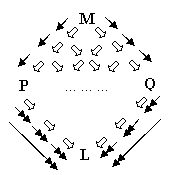
We can now use the Diamond property for
=> in order to get, tile by tile , a term L such that
P => ... => L
<=...<= Q
Now, by using property (i) above we can obtain
P --> ... --> L <--...<-- Q
That is
P --->> L << --- Q